We are thrilled to share a massive milestone for Rewind and the Carbon Dioxide Removal (CDR) market. As of today, the draft Biomass Storage in Subsurface MinesModule - developed by Isometric - has moved to the Public Consultation phase, and we are proud to have provided extensive feedback during its development.
At Rewind, we are working to unlock a solution that balances the infamous "impossible triangle" of CDR:
Permanence: Storing carbon 1,000 meters deep for 1,000+ years.
Transparency is key in this market. By subjecting our approach to Isometric’s rigorous scientific Standard, we are ensuring that our credits represent real, verified, and durable climate impact. But getting here wasn't simple - it was a journey of deep scientific engineering.
Embracing Complexity
When we approached Isometric six months ago, we pointed to their existing protocols and asked: “What storage requirements do we need to meet to stand up to verifiable, high-durability, 1000-year permanence?”
What followed was a rigorous game of scientific ping-pong. We proposed approaches, they challenged them, and we iterated, providing key feedback during the module’s development. We scrutinized everything - leakage pathways, reversal risks, realistic and science-based monitoring approaches, occupational safety, and environmental and social safeguards.
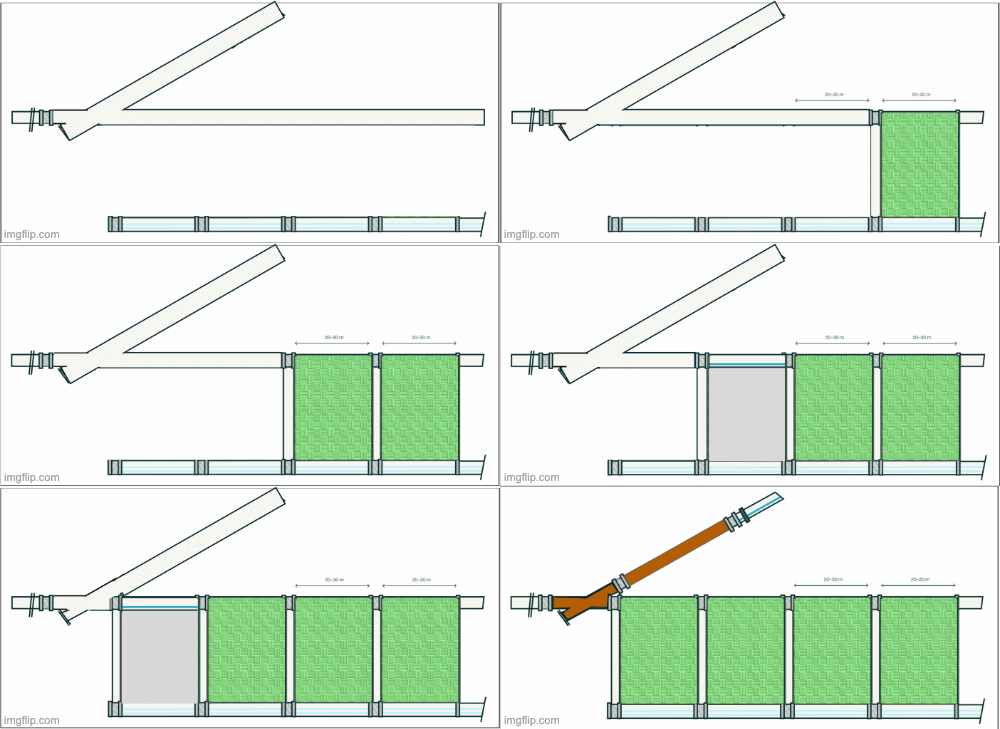
The core challenge is the unique environment we operate in. The mine we operate in features a highly complex structure that requires a stepwise backfilling sequestration pathway. This isn't a simple, linear process. We had to map out every potential leakage pathway (no matter how small) and address them in a way that was realistically actionable within the mine's operational constraints.
The resulting methodology doesn’t shy away from this reality; it embraces it. You can see this rigor in action in our chamber sealing process (visualized below), which is designed to be airtight.
Ensuring Biomass Sustainability
Storage is only half the equation. To ensure our impact is net-positive, we must verify where our biomass comes from.
We are currently working with Preferred by Nature to create a forestry risk assessment, building on the extensive groundwork done by our team, including deep-dive forms and document collection. Additionally, we have recently completed a survey together with a local, third-party NGO of over 20 sawmills across the region to verify the counterfactual and alternative uses of residual biomass (sawdust, wood edges, bark). This confirms that Rewind’s biomass use won't cause leakage or displace existing essential uses
Contributing to the development of this module with Isometric was an interesting and enlightening process, full of logical and scientific discussions about a first-of-a-kind project, setting the stage for additional subsurface mines to serve as CO2 sinks.
We would like to thank the entire Isometric team, our scientists, Dr. Josh Steinberg and Dr. Nitai Amiel, our Co-founder & COO Eitan Brettler, and everyone on our team who helped make this happen.
Join the Consultation
We believe that high-quality CDR requires high-quality scrutiny. We invite the scientific community, industry peers, and the public to review this new approach.
Announcing a New Offtake Partnership with Wild Assets
We’re excited to share a new partnership with Wild Assets. We’ve signed a long-term offtake for future carbon removal credits from our Deep Mine Storage project in Georgia.
DMS Georgia: World’s first deep mine carbon storage
Today is an exciting milestone for us at Rewind: we are launching our DMS Project in the city of Tkibuli, Georgia - the world’s first commercial Deep Mine Storage (DMS) facility. A carbon removal project that is meets all key criteria: permanent, operationally scalable, reasonably priced, and grounded in the Earth’s own natural processes. We source residual sawmill biomass, and inject it into sealed underground disused mine chambers, where the isolation and anoxia will preserve the solid plant carbon for geological time scales.


.png)